
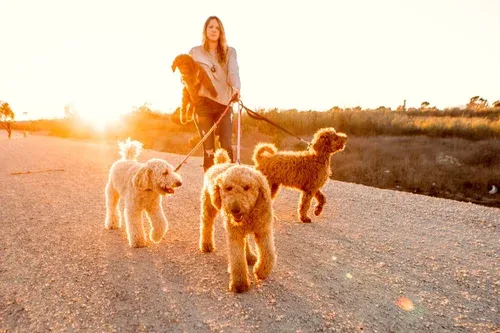
Goldendoodles come in different generations, including F1, F1B, and multigen goldendoodles. Understanding the differences helps families choose a puppy that matches their lifestyle, expectations, and allergy sensitivities. Each generation has unique traits related to coat type, temperament, and predictability. Knowing these differences can also help families select a responsible breeder and ensure a healthy, happy multigen goldendoodle puppy.
Quick Overview
F1 goldendoodles are the first generation, a direct mix of a golden retriever and a poodle. F1B goldendoodles are backcrosses, usually bred from an F1 and a poodle. Multigen goldendoodles are puppies bred from two goldendoodles of at least two generations, creating multiple generations in the lineage. Multigen and F1B puppies have a higher chance of a low-shedding coat. Multigen goldendoodles and F1B dogs exhibit these hypoallergenic coat traits more, compared to F1 dogs.
Table of Contents
- Understanding F1 Goldendoodles
- Understanding F1B Goldendoodles
- Understanding Multigen Goldendoodles
- Coat and Shedding Differences
- Temperament and Personality Traits
- Health Considerations Across Generations
- Choosing the Right Generation for Your Home
- Final Thoughts
- FAQs
Understanding F1 Goldendoodles
F1 goldendoodles are the first-generation puppies bred by crossing a purebred golden retriever with a purebred poodle. Their coats can vary widely, from wavy to curly, and shedding levels are less predictable. F1 dogs often have strong energy levels and can be excellent family companions. They tend to inherit a balanced mix of traits from both parent breeds. Families who want a more predictable coat may need to commit to regular grooming and brushing.
Understanding F1B Goldendoodles
F1B goldendoodles are considered backcrosses. Most F1B puppies are bred from an F1 goldendoodle and a poodle. This generation is designed to increase the chances of low-shedding and curlier coats. F1B dogs are often preferred by families with mild allergies. They usually retain the friendly temperament of the F1 generation while being slightly more consistent in appearance and coat type.
Understanding Multigen Goldendoodles
Multigen goldendoodles are bred from two goldendoodles that have already had at least two generations of goldendoodle ancestry. This creates multiple generations in the pedigree, which can include F2, F3, or F4. Multigen puppies are highly valued for predictability in coat type, size, and temperament. They also often have more stable personalities and a greater likelihood of hypoallergenic coats. Multigen breeding allows breeders to refine traits while maintaining genetic diversity.
Coat and Shedding Differences
Coat type is one of the main differences between generations. F1 goldendoodles can have straight, wavy, or curly coats and may shed moderately. F1B and multigen goldendoodles are more likely to have wavy to curly coats and shed less. Studies show that consistent coat grooming reduces allergic reactions in sensitive individuals. Families concerned about shedding or allergies often choose F1B or multigen puppies for this reason.
Temperament and Personality Traits
All goldendoodles are known for being intelligent, friendly, and social. F1 puppies may show a wider range of behaviors because of their mixed parentage. F1B and multigen goldendoodles are generally calmer, more predictable, and often easier to train. Early socialization and routine care are key to developing well-adjusted adult dogs, regardless of generation.
Health Considerations Across Generations
Genetic diversity is important in maintaining a healthy dog. F1 puppies benefit from hybrid vigor, which can reduce the risk of some inherited conditions. Multigen and F1B dogs can also be healthy if breeders carefully test for hip dysplasia, eye issues, and heart conditions. According to a source, puppies from health-tested parents are less likely to develop hereditary health problems. Families should always ask for health clearances when selecting a puppy.
Choosing the Right Generation for Your Home
Families should consider coat preferences, allergy sensitivity, temperament, and grooming commitment when choosing a generation. F1 puppies may appeal to those who want a more energetic companion and are prepared for moderate shedding. F1B and multigen puppies may suit families seeking predictability in coat, calm behavior, and low-shedding traits. Understanding these differences ensures a better match for home life and lifestyle needs.
Final Thoughts
F1, F1B, and multigen goldendoodles each have unique traits in coat, temperament, and predictability. Learning the differences helps families make informed decisions about which generation fits their lifestyle. Choosing a responsible breeder is also critical to ensure the puppy is healthy and well-socialized.
Windsong Doodles is an OC goldendoodle breeder in Southern California that focuses on raising puppies with healthy temperaments and well-planned genetics. Families interested in learning more about upcoming litters are encouraged to contact them today.
FAQs
1. What is the difference between F1, F1B, and multigen goldendoodles?
F1 is the first generation, F1B is a backcross with a poodle, and multigen is multiple generations of goldendoodle ancestry.
2. Which generation is best for allergies?
F1B and multigen goldendoodles are most likely to have low-shedding coats, making them better for families with mild allergies.
3. Are multigen goldendoodles more expensive than F1 puppies?
Yes, multigen puppies often cost more due to predictability, refined traits, and health testing.
4. Do F1 goldendoodles shed more than other generations?
Yes, F1 dogs can have variable coats and may shed more than F1B or multigen puppies.
5. Are all generations easy to train?
Yes, all generations are intelligent and trainable, but F1B and multigen puppies tend to be more predictable in temperament.
6. How can I ensure my goldendoodle is healthy?
Choose a responsible breeder who provides health clearances for parents and follows proper socialization and care practices.